SEO and GEO and AEO, Oh My! How to Write Website Copy for Google and AI
SEO… GEO… AEO… AIO…
OMG.
If you’ve been anywhere near a marketing conversation lately, you’ve probably heard at least one of these acronyms thrown around like confetti.
Maybe you nodded along. Maybe you quietly Googled it later. (No shame — that’s kind of why we’re writing this.)
The way people find businesses online has changed dramatically in the last few years. It used to be basic enough: rank on Google, get clicks, book clients.
Now, your ideal customer might never visit Google at all. She might ask ChatGPT, “Who’s the best brand photographer in Denver?” and just go with whoever gets mentioned.
That means your website copy needs to work harder than ever — not just for search engines, but for AI engines, too.
Don’t panic. As website copywriters, we work in this world every day, and we’re going to explain everything you need to know.
In this ultimate guide to SEO, GEO, and AEO for small businesses, you will learn:
- What’s the difference between SEO, GEO, AEO, and AIO?
- How they’re all related
- 5 steps to boost your online visibility in 2026
- How to check if your website is SEO-, AI-, and human-friendly
- FAQs about SEO, GEO, and AEO for small businesses
Let’s start with the alphabet soup, shall we?
What’s the Difference Between SEO, GEO, AEO, and AIO?
SEO (Search Engine Optimization): The OG
SEO is the acronym you’ve probably heard the most. It’s been the backbone of online visibility for decades.
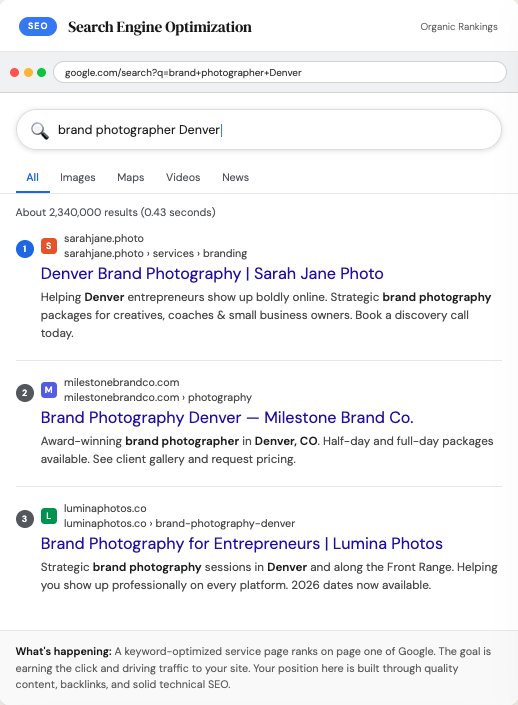
What Is SEO?
Search engine optimization (SEO) is the practice of optimizing your website so it ranks higher in traditional search engine results (primarily Google).
Goal of SEO
Drive traffic. Get people to click to your site from the search engine results page (SERP).
How SEO Works
SEO involves practices like:
- Choosing the right keywords
- Earning backlinks from reputable sites
- Writing high-quality content
- Optimizing the technical foundations of your site (e.g., fast load times, mobile-friendly design, secure HTTPS)
Think of SEO as building your reputation with Google. The better your content, the more trustworthy your site. The more trustworthy your site, the higher you climb on SERPs.
A common misconception to clear up: Keyword stuffing is not SEO. Cramming “brand photographer Minneapolis” into every other sentence will actually hurt your rankings. Google’s smarter than that — and so are your readers.
Why SEO Matters
Google still processes an estimated 16.4 billion searches per day. Traditional search isn’t going anywhere. It’s still the foundation everything else is built on. The brands that invest in solid SEO now will have a head start on GEO and AEO too.
GEO (Generative Engine Optimization): SEO’s AI-Savvy Cousin
GEO is newer on the scene, but it’s quickly becoming just as important as SEO… maybe even more so.
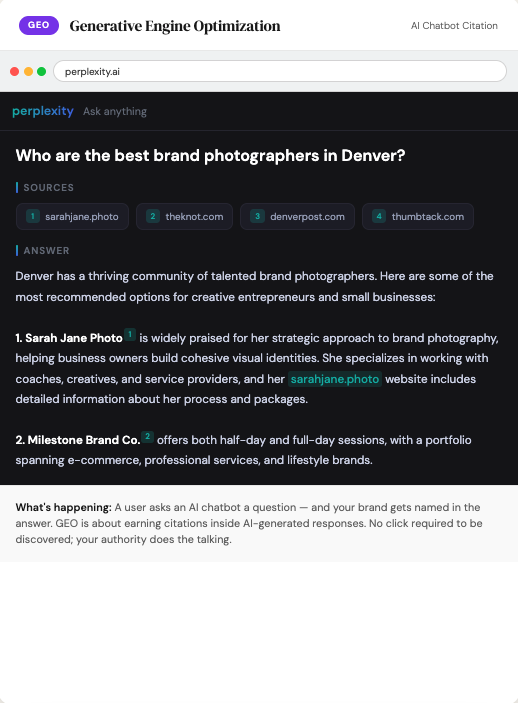
What Is GEO?
Generative engine optimization (GEO) is the practice of optimizing your content so AI-powered platforms (like ChatGPT, Perplexity, Google Gemini, and Claude) mention, cite, or recommend your brand when users ask relevant questions.
Goal of GEO
Build authority. Get your brand into the conversation happening inside AI chatbots and generative search tools.
How GEO Works
AI engines synthesize information from multiple sources to generate answers. They favor content that is:
- Factually accurate
- Well structured
- Comprehensive
- Backed by credible sources
Unlike Google, which returns a list of links, an AI chatbot gives one synthesized answer — and only a handful of brands get cited.
Think of it this way: SEO gets you found. GEO gets you trusted enough to be the answer.
Why GEO Matters
ChatGPT now reaches over 900 million weekly users. Google’s Gemini app has surpassed 750 million monthly users. AI search tools are estimated to soon power around 50% of global queries.
If your website copy isn’t optimized for these platforms, you’re invisible to up to half your potential clients.
AEO (Answer Engine Optimization): GEO’s Straightforward Sister
AEO is closely related to GEO — so closely that the terms are sometimes used interchangeably. But there’s a useful distinction.
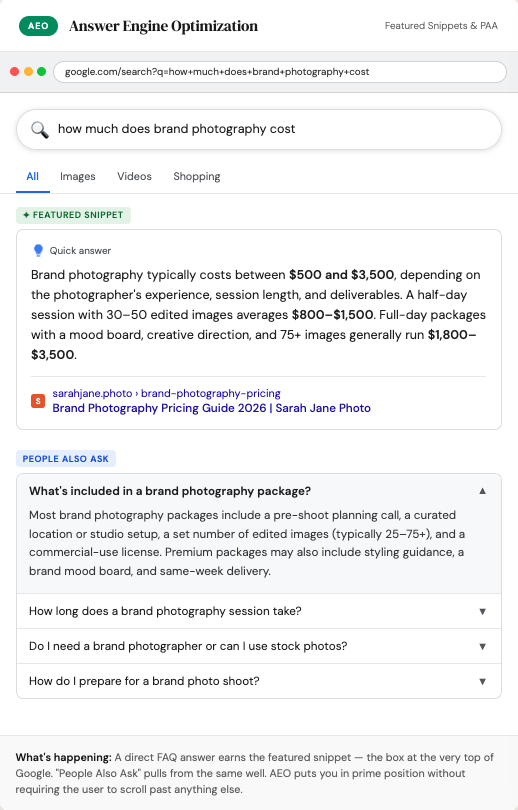
What Is AEO?
Answer engine optimization (AEO) is the practice of optimizing your content to appear in direct answer formats, like:
- Google’s featured snippets
- “People Also Ask” boxes
- Voice search results
- AI Overviews
Goal of AEO
Increase visibility — even when users don’t click through to your site at all. (Yes, that’s a thing now.)
How AEO Works
AEO is all about writing in a clear, direct question-and-answer format. When someone asks Google, “How much does brand photography cost?” and a box pops up at the top of the page with a direct answer, that’s AEO in action.
Your content needs to answer questions concisely (ideally in 40–60 words) so search and AI engines can extract and display it.
A key distinction from GEO: GEO focuses on being cited by AI chatbots. AEO focuses on appearing in structured answer formats across both traditional and AI-powered search. They share many of the same best practices, but AEO leans especially hard on direct, concise answers.
Why AEO Matters
An estimated 60% of searches now end without a single click, meaning your potential client found what they needed right there on the results page.
If your copy isn’t written to be that answer, you’re invisible at the exact moment someone is looking for a solution like yours.
AIO (AI Overviews): AEO’s… Child?
You’ve almost certainly seen AI Overviews: those AI-generated summaries that appear at the very top of Google search results, above all the traditional blue links.
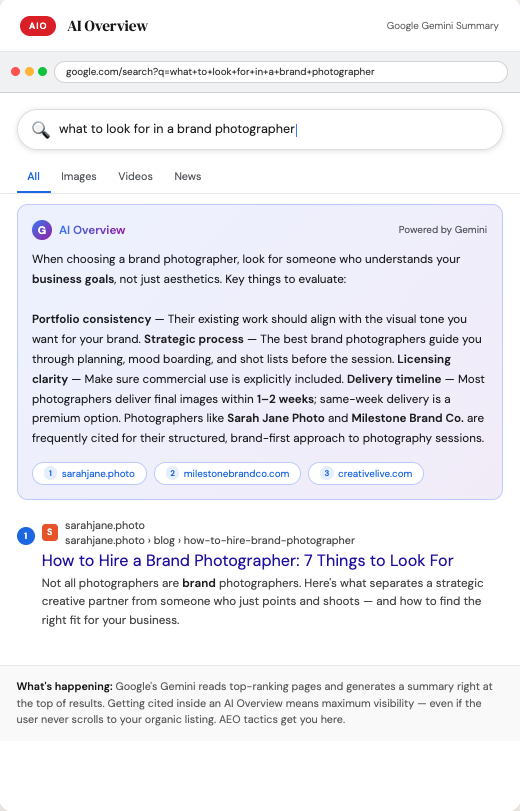
What Is AIO?
An AI Overview (AIO) is when Google’s Gemini reads the top-ranking web pages and synthesizes a summary answer, which is displayed front and center on the search results page.
Why AIO Matters
AI Overviews are appearing in at least 16% of all searches — and significantly more for comparison or high-intent queries (read: the kind of searches your potential clients are making). If your content shows up in an AI Overview, you get enormous visibility, even if the user never clicks on your site.
So AIO is not a strategy like the others? Not exactly. You use AEO strategies to get into an AIO. Write clear, direct answers to questions your audience is asking, and you dramatically increase your chances of being featured.
Wait — How Are These All Related?
SEO, GEO, AEO, and AIO aren’t four separate strategies. They’re layers of the same strategy.
Think of it like this:
- SEO is your foundation. Without solid SEO, nothing else works. AI platforms like Perplexity and ChatGPT often pull from Google’s top-ranking results, so if you’re not ranking traditionally, you’re probably not showing up in AI answers either.
- AEO builds on that foundation by making your content easy for both search engines and AI to extract and surface as direct answers.
- GEO extends your reach into AI chatbot responses across multiple platforms, not just Google.
- AIO is one of the end results: appearing in Google’s AI-generated summaries, which get prime real estate at the top of the search page.
Here’s a tip that should make you breathe a little easier:
The things that make your website copy good for humans also make it good for search engines and AI. High-quality, clear, authoritative writing wins everywhere.
Here’s What They All Have in Common
- Valuable content that demonstrates your real expertise
- A clear understanding of what your audience is actually searching for
- Structured data (schema markup) that helps search engines and AI crawlers understand your content
- A fast, mobile-friendly website that’s easy for users to navigate and for crawlers to read
5 Steps to Boost Your Online Visibility in 2026
You don’t need to overhaul your entire website overnight. Start here.

1. Know What Your Audience Is Looking For
The days of plugging a keyword into your copy and calling it done are over. What matters now is understanding what your audience is actually trying to accomplish when they search.
Are they trying to learn something? Compare options? Hire someone right now? The way you write your website copy should match where they are in their decision-making process.
How to Research User Intent
- Google your primary keywords and look at what types of pages rank (blogs? service pages? FAQs?)
- Check the “People Also Ask” section on Google to see real questions your audience is asking
- Look at your own inquiry forms and DMs for recurring questions
- Use tools like Google Search Console, Semrush, or even just Google Autocomplete
Pro tip for AI visibility: Write content that addresses the exact conversational questions your audience would type into ChatGPT or Perplexity. “What should I look for in a wedding photographer?” is an AI-search-friendly question. “Photographer tips” is not.
2. Implement Structured Data
We know… this tip sounds very ho-hum. “Schema markup” may sound like something only web developers care about. But hear us out, because this one is worth understanding.
Schema markup is code added to your website that helps search engines and AI explicitly understand what’s on your page. Instead of having to guess whether your page is a service page or a blog post or a list of FAQs, the search engine just knows.
Best Types of Schema Markup for Small Businesses
- FAQ schema: Marks up your Q&A sections so they can appear as rich results in Google, and so AI tools can easily extract and cite your answers
- How-To schema: Great for tutorial or process-based content
- LocalBusiness schema: Tells search engines your business name, location, hours, and service area
- Person schema: Establishes your identity as an expert, which supports what Google calls E-E-A-T (Experience, Expertise, Authoritativeness, Trustworthiness)
Take a sigh of relief: you don’t necessarily have to write the code yourself. Your web platform or a developer can handle implementation. But knowing it exists and asking for it is on you.
3. Write Clear, Scannable Content
If your website copy reads like one long, dense paragraph, it’s not going to perform well — for humans or for AI.
Both People and Search Engines Love Content That Is…
- Organized with clear headings (we’re talking H1, H2, H3, and H4 tags)
- Broken into shorter paragraphs (1–3 sentences is the sweet spot)
- Enhanced with bulleted or numbered lists where appropriate (and other scanner-friendly formatting)
- Frontloaded (the most important information comes first, not buried at the end)
For GEO specifically: AI engines rely on a process called Retrieval-Augmented Generation (RAG), where they pull from external sources in real time. Content that is cleanly structured, well-organized, and fact-dense is far more likely to get pulled and cited than rambling, unstructured prose.
This doesn’t mean your copy has to be dry or boring. (It absolutely should not be.) It means that structure and style can — and should — coexist. That’s what great copywriting is: clear and compelling.
4. Answer Questions Directly (Especially in Your FAQs)
We’ve written a whole post on the importance of FAQs on your website, but here’s the short version: FAQs are gold for SEO, GEO, and AEO. (Sorry to throw in yet another acronym!)
When writing FAQ answers, the goal is to answer the question completely and clearly in 40–60 words. Why that range? Because that’s the sweet spot for featured snippets and AI extraction. Long enough to be thorough, short enough to be usable.
Tips for FAQ Copy that Performs
- State the answer in the very first sentence (don’t bury the lede)
- Phrase the question the way your audience would actually ask it (“How long does a brand shoot take?” not “Duration of Services”)
- Use plain language (no jargon or corporate-speak)
- Include specific details where helpful (timeframes, prices, numbers)
FAQs with schema markup are especially powerful. They signal to Google and AI platforms that your content is structured, authoritative, and ready to be featured.
5. Ensure Your Technical Foundation Is Solid
No amount of beautiful copy will save a slow, broken website. Before obsessing over every word on your service page, make sure your site is technically sound.
Your Technical SEO Checklist
- Fast loading speed (aim for under 3 seconds; use Google’s PageSpeed Insights to test)
- Mobile-friendly design (a non-negotiable in 2026, as Google indexes mobile-first)
- Secure HTTPS connection
- Clean site structure with logical internal linking
- No broken links or crawl errors
- An XML sitemap submitted to Google Search Console
A quick note on website platforms: This is exactly why we love Showit as a website platform for creative entrepreneurs. It’s built with strong technical foundations, is fully mobile-optimized, and makes it easy to add schema markup, HTML tags, and other SEO essentials without needing a developer. (Get your first month free with our affiliate code here.)
Is Your Web Copy SEO-Friendly? (And AI-Friendly, and Human-Friendly?)
While all these acronyms might sound a bit technical, here’s the good news:
Optimizing for search and AI doesn’t mean writing for robots. It means writing for real people.
If you write clearly, helpfully, with a distinct voice and genuine expertise, you’re probably already writing in a way that search engines and AI platforms can understand and trust.
This, ironically, is where a lot of AI-generated copy falls short.
AI writing tools can produce technically correct content. They can stuff in keywords and structure a page. But they can’t replicate your actual expertise, your authentic voice, or the nuanced understanding of your ideal client that comes from years of working in your industry.
And increasingly, search engines and AI platforms are getting better at detecting — and deprioritizing — generic, low-personality content.
This is especially important for the core pages on your site: home, about, services, etc. While AI can help with ideation, research, and even some blog content, you should pay particular attention to the most-visited pages. That’s what Google, AI, and your audience all care about most.
E-E-A-T (Experience, Expertise, Authoritativeness, Trustworthiness) is still Google’s north star. And the “E” for Experience is there for a reason: AI can’t have real-world experience. You can.
The brands that will win in AI search aren’t the ones that publish the most content. They’re the ones whose content is genuinely useful, distinctly human, and clearly authoritative.
That’s the case for investing in custom website copy — not just technically optimized copy, but copy that actually sounds like you, speaks directly to your dream client, and earns the trust of both human readers and AI engines.

Need Help Writing World-Class Website Copy in 2026?
The search landscape has gotten more complex, but the fundamentals haven’t changed as much as the acronyms suggest.
Write clearly. Answer real questions. Build genuine authority. Make your site easy to use and crawl.
Do that consistently, and you’ll be well-positioned, whether someone finds you on Google, in a ChatGPT recommendation, or via an AI Overview.
Of course, knowing what to do and actually doing it well are two different things. Website copywriting that hits all these marks — optimized, strategic, and written in a voice that sounds like you — is a craft. And it’s exactly what we do here at Quotable Copy.
If that sounds tempting… let’s talk.
[ Explore Our Website Copywriting Services ]
FAQs about SEO, GEO, and AEO for Small Businesses
What’s the Difference between SEO and GEO?
SEO (search engine optimization) helps your website rank in traditional search engines like Google. GEO (generative engine optimization) helps your brand get cited or recommended by AI platforms like ChatGPT, Perplexity, and Google Gemini.
SEO is the foundation. GEO builds on it to reach audiences using AI-powered search tools.
Do I Need to Do All of These (SEO, GEO, and AEO)?
The good news is that most best practices for SEO, GEO, and AEO overlap. High-quality, well-structured content that answers your audience’s real questions helps with all three.
You don’t need three separate strategies. You need one strong content strategy, executed well.
Will AI Kill My Website Traffic?
AI is changing website traffic, not killing it. Some research suggests that overall site visits may decline due to AI Overviews (which answer questions without requiring a click). However, brands with optimized content are actually seeing increases in homepage traffic and higher-intent visitors — especially when their brand is cited in the AIO.
Focus on being genuinely helpful and authoritative, and you’ll stay relevant.
Can I Just Use AI to Write My Website Copy?
You can — but it often shows, and it’s increasingly a liability. Google and AI search tools value E-E-A-T: Experience, Expertise, Authoritativeness, Trustworthiness.
AI-generated content can hit some of those marks, but it can’t authentically demonstrate your real-world experience or replicate a distinctive brand voice. Human-written copy tends to convert better, too.
What’s the Easiest First Step to Improve My Website SEO and AI Visibility?
Add a well-written FAQs section to your key pages. Make sure each answer is clear, direct, and 40–60 words. This single move can improve your chances of appearing in featured snippets, AI Overviews, and AI chatbot responses all at once.
[ See All Articles ]
Keep up the good reading